Hey all. Shelly's napping, so I'll take this one. It's another stop on the Houses of Common blog tour. Cynthia Rodriguez is currently serving in the US Army in Afghanistan. She and her agent are seeking a publisher for her novel. In the meantime, she offered to interview me. Here it is!
http://cynthiaarodriguez.wordpress.com/2014/03/05/author-derick-william-dalton-and-houses-of-common/
This being my first time ever interviewing an author, I’m a bit nervous. But I assure you all, DWD is pretty awesome. Don’t worry, I tried to tone down the social awkwardness and keep my questions helpful to you as well as interesting. So, without further ado, let’s grab a seat and get this interview rolling! Mr. Dalton?
We’re a good match, because this is my first time being interviewed as an author. I’m no stranger to fame, though. I got my picture in the paper for the fifth grade science fair, and in high school, I had an interview with a local TV reporter which did not air.
1. I’ve spoken a bit about authors and their wacky inspiration. I know mine came from a Disney coloring page. Another is Stephenie Meyer, revealing the Twilight Saga being inspired by a dream. Where did the inspiration for Houses of Common come from?
Wacky. That’s a good word choice. Two sources congealed the ideas in my head and sparked the urge to start writing Houses of Common. The first was an article I read when I was supposed to be working on my thesis for a master’s degree in education. How’s that for hypocrisy? A teacher not doing his homework. The article was by Robert Zubrin, entitled Getting Space Exploration Right. Here’s a link, because it’s an awesome piece: http://www.thenewatlantis.com/publications/getting-space-exploration-right. Zubrin noted the discovery and colonization of North and South America changed the world superpowers, in that those who colonized became the powers, and those who backed out, well Portugal? Who’s that? He predicted the same will occur with colonization of the moon and Mars. See how that’s more interesting than articles on educational law and classroom management?
The other was a botany class. Genetics and medical stuff is what hooks me, not plants. But after a few classes, I changed my attitude. One day in particular, the reproductive cycle of ferns was the topic. The offspring look nothing like the parent fern. It’s more like a miniature water lily. The lily-looking plant’s offspring is the fern. It’s called alternation of generations, it’s really weird, and I started wondering what that would look like in a humanoid. That’s where the main character’s species came from. Thanks Dr. Roberts!
But here’s what I need to know: Did your inspiration come before or after the Disney page was colored?
2. The coloring page remains uncolored. There’s this completely sensible part of me that says if I color it, I may ruin the luck I’ve had so far in writing. Like someone snapping their fingers and I wake up from a dream! Silly, I know. But it’s a small fear of mine. Which brings me to my next question. Something I constantly discuss on this blog is fear. I truly believe the Jack Canfield quote: “Everything you want is on the other side of fear.” What is your greatest fear as an author?
You do realize you just handed your enemies full knowledge of your kryptonite. All they have to do is locate the the Magic Disney Page of Fortune, and defile it with cadmium red, or more fittingly, mermaid fin green.
My fears? In high school and college when I taught swimming lessons, and when teaching high school biology, I’d occasionally have nightmares about the job. In them, I’d swear in front of a bunch of six-year-olds, and wake up horrified at the pool-time fun wiped off their sweet little faces. Or I’d slip an off-color joke into a biology lecture, and have to explain to parents and the principal. I never did any of those things, but the dream was a recurring and disturbing one. Now, I worry about writing something that could be misinterpreted and interrupt the flow of the story with the similar jolt my nightmares would have given in real life. Hooray for beta readers and editors!
A bigger fear? I have a pact with my sister, Jessica Parsons (she has a completed novel, Time Walker, and is searching for agents right now). We’ve agreed to be brutally honest if we notice the other becoming an arrogant, insufferable jerk. We’re all familiar with authors who lose their personable nature in direct proportion to success. When in doubt, I think WWBWD. What would Bill Watterson do?
3. As my readers know, I cannot write comfortably without music and usually I’ll post a song at the end of each post. Music is something that gives me strength as well as direction and I’ve always wondered if all authors feel this way or if I’m the only one. Do you need absolute silence while writing or do you listen to music? If you listen to music, what does your soundtrack look like?
When I’m writing a first draft, silence is my muse. Sometimes the two together are a salve. Occasionally instrumental music is helpful, my favorite being my Pandora station seeded with “John Williams” as artist. Heroic movie themes for my heroic propaganda. (Hey, could that be a new genre name?) But lyrics at that phase are a killer. Can’t write anything with someone’s voice in my ears. Editing is another story. My kids can even be at the same table asking me questions about homework without throwing me off. So, I sometimes broaden the music when revising drafts. A few songs in particular have helped me with characters:
Ranyk – the protagonist of Houses of Common is a terraformer whose deep respect for life is counterbalanced by issues with authority. The Ramones had Ranyk in mind specifically when they recorded their version of What a Wonderful World. Really. Look it up. http://www.youtube.com/watch?v=F-3ox-6WhBA
Sckiik – Ranyk’s sister is a former cop and current head of security for her species’ US Embassy. A spiritual person with a violent job, I heard this hymn by the cover band Mishmash and now it’s the soundtrack in my brain during her girl-power scenes. http://grooveshark.com/#!/s/Do+What+Is+Right/2GOa2P?src=5
Dr. Perinath – She’s Ranyk’s boss, the one authority figure who knows how to wrangle him. This song has personal and historical meaning for her, and it’s one of my favorites, too. Can’t beat 40s big band! http://www.youtube.com/watch?v=fhyhP_5VfKM
Sean and Qi - Theirs is a Romeo-and-Juliet story with a happier outcome (so far), a conspiracy theorist twist, and a big pile of reality to irk them. That’s all the info you get until book three (wicked laugh) but here’s a great song. The video? Kind of lame. It would be WAY better if it was about Sean and Qi. http://www.youtube.com/watch?v=s1R_txIuuio
4. I’m fairly new to writing and have yet to be published. So for you to have been published and me to be able to ask you questions, the next one is obvious: Any advice for writers/new authors?
As I’ve listened to other writers answer this question, I’ve realized there are almost that many paths to the profession. Advice I’ve been given doesn’t often work for me. It was trial and error in figuring out how to craft a story. So, this may be meaningless to many, but here’s what I’ve learned.
Good feedback is painful and your friend. It’s scrubbing the gravel out of road rash. It’s setting the subluxed ulnar fracture. It’s incising and draining the infected cyst. The most useful feedback I received from editors and beta readers nearly always left a bruise.
Well, wasn’t that pleasant.
5. I agree. The best things in life (and writing) are usually the hardest to do. Something else I find difficult at times? Naming characters. I think naming characters can be one of two things: instantaneous or something absolutely annoying. How did you come up with your characters’ names (Sckiik, Ranyk, etc.)?
You’ll think I’m joking, but I swear I’m not making this up. The alien names are the product of an arcane ritual in which I extend my index fingers, close my eyes, and tap out a rhythm on the keyboard. I never learned to type without looking, so it’s truly random. Then I look for interesting phoneme strings and add a vowel or consonant as needed. I’ll forgive anyone for thinking that’s just cheating. Or for stealing the idea.
When choosing from existing names, sometimes I pick one with a meaning to match their purpose. Sometimes one that sounds like it fits and no other reason. Like your instantaneous method. One of my character’s names sounds like the French translation of a phrase which suggests subterfuge. I found that by accident and couldn’t pass it up. Travers le rideau. Through the curtain.
6. This blog is dedicated to sharing my journey as a writer. From typing the first words of this novel to now; what’s your story?
If I write the rest of my novels like the first, my writing career will be a very short story. But I won’t, so it won’t. Because I’m not going to interrupt any more novels with starting and finishing grad school two different times. I also won’t interrupt the next novel three times for adorable little babies (or unadorable ones). Not going to build my own house again, ever. In short, I’ll have the sequel done in six months instead of ten years.
Maybe I just inadvertently shared some advice. About not giving up or hanging it up or hanging yourself.
Here’s how come I only clicked pause and never stop. I like the process of writing. I like learning new things and letting them loose in my head to see what random connections they’ll make. I like outlining a story and putting it into complete sentences. (Complete sentences? Did anyone else’s internal fourth grader just moan and groan in teacher-mediated torment?) I like walking away for a week and coming back to a chapter that’s a really enjoyable read. None of my other jobs in research or education or medicine can boast that all their facets are enjoyable. Hmm. Maybe it’s the walking away for a week…
It’s been such a pleasure speaking to Derick William Dalton and I sincerely encourage you all pick up his new book, Houses of Common. And if you’re an author, feel free to reach out to me for a spotlight post as well. After all, if authors don’t help authors, who will?
All my love,
Cynth
Wednesday, March 5, 2014


Tuesday, March 4, 2014
Bearded Scribe
What I think DWD means is "bearded dragon." Much cooler than a scruffy mammal who thinks he's eloquent. But apparently he was a guest poster on their blog, and wants me to relay it to all of you.
Here's the link. The full post is also below. You know what to do.
http://thebeardedscribe.blogspot.com/2014/03/guest-post-by-derick-william-dalton.html
PS - Buy a copy of his book. This polar vortex and a burned out heat lamp don't mix.
A few weeks ago I attended the Life, the Universe, and Everything sci-fi and fantasy symposium in Provo, Utah. It was completely worth two days in the car to get there. I was a panelist for one of the sessions, and a lady in the audience asked a question that kept me thinking.
“I know the characters in my novel. I know the conflict and the plot. But I don't have a world in which to put them.”
I interpret literally the concept that art imitates life. Some of my best ideas have come from one of my college textbooks, Invertebrates by Brusca and Brusca. That book makes the Mos Eisley cantina look like retired white folks playing bingo. Sometimes I reread it just to overload my brain with weirdtasticness.
As this lady asked about creating a world for her fantasy series, I pondered a phrase commonly used in biology. Form follows function. If some part of an organism looks like it should perform a certain job, likely that's exactly what it does. It holds true for the bizarre appendages and embryology stages of arthropods. Though more abstract, behavior is such a formation. In mammals, it's a product of the frontal cortex of the brain. It's all about neurotransmitters and receptors and genetics. The function of which, speaking broadly, is to help an organism survive and reproduce. (A high school student once told me my biology class was boring. “Why?” I asked. “All we're talking about is food and sex.” He paid closer attention after that.) In humans, behavior is also involved in the other facets of our well-being. Could an author view her characters as an extension of the world's personality?
Here's a real life example.
Bonobos, Pan paniscus and formerly known as pygmy chimpanzees, are native to an area of the Democratic Republic of the Congo. It's a lush and fertile environment. They're a peaceful species, and are too busy mating to fight. Chimpanzees, P. troglodytes, are native to other areas, many of which are dry and harsh. They're mean. Males patrol the borders and kill other chimpanzees. They backstab each other for dominance. Primatologists hypothesize the link between these behaviors and habitat is causal rather than coincidental.
So, we just need to invent ethnic stereotypes and reverse-engineer a world from them, right? Why not? But it needs to be more interesting than that, because there can be so many variables. After living in Canada, I can't go back without the accent following me for days. Being there changed me, and more than just knowledge of what ten degrees Celsius feels like or the first verse of “O, Canada.” I was only there six months. What about an entire life? As a physician assistant, every day I see kids whose healthy or unhealthy habits are identical to those of their parents or grandparents. For an author, the bonus is that the more entrenched a pattern of behavior, the bigger the payoff for the character and the reader when it's overcome.
What if that pattern goes as deep as geology or history or DNA? Now we're talking heroic.
This brings up the question of personal decision. A fun difference between mythic heroes, tragedies, comedies, and other forms of literature is the question of fate. Destiny. A character in book two of my Houses of Common series (Meaner Sort, out later this summer) pondered this question. She's an alien and head of security for her people's ambassador to the United States. She suffers setbacks in the form of failing to prevent an assassination, helplessly discovering xenocide, and worrying about the safety of her loudmouth brother. Leaving a hotel, she sees a holographic rendering of Paul Gaugin's painting Where do we come from? What are we? Where are we going?, and reflects on the Ambassador's attack. “We come from the genes of our forebears, Monsieur Gauguin,” she whispers. “We are slaves of our instincts with a certain leeway of behaviors we must control or others will do so for us. But going where?”
I wish I would have thought of all this when that lady at the symposium asked her question. I guess that's why I write novels instead of run for office.
Here's the link. The full post is also below. You know what to do.
http://thebeardedscribe.blogspot.com/2014/03/guest-post-by-derick-william-dalton.html
PS - Buy a copy of his book. This polar vortex and a burned out heat lamp don't mix.
A few weeks ago I attended the Life, the Universe, and Everything sci-fi and fantasy symposium in Provo, Utah. It was completely worth two days in the car to get there. I was a panelist for one of the sessions, and a lady in the audience asked a question that kept me thinking.
“I know the characters in my novel. I know the conflict and the plot. But I don't have a world in which to put them.”
I interpret literally the concept that art imitates life. Some of my best ideas have come from one of my college textbooks, Invertebrates by Brusca and Brusca. That book makes the Mos Eisley cantina look like retired white folks playing bingo. Sometimes I reread it just to overload my brain with weirdtasticness.
As this lady asked about creating a world for her fantasy series, I pondered a phrase commonly used in biology. Form follows function. If some part of an organism looks like it should perform a certain job, likely that's exactly what it does. It holds true for the bizarre appendages and embryology stages of arthropods. Though more abstract, behavior is such a formation. In mammals, it's a product of the frontal cortex of the brain. It's all about neurotransmitters and receptors and genetics. The function of which, speaking broadly, is to help an organism survive and reproduce. (A high school student once told me my biology class was boring. “Why?” I asked. “All we're talking about is food and sex.” He paid closer attention after that.) In humans, behavior is also involved in the other facets of our well-being. Could an author view her characters as an extension of the world's personality?
Here's a real life example.
Bonobos, Pan paniscus and formerly known as pygmy chimpanzees, are native to an area of the Democratic Republic of the Congo. It's a lush and fertile environment. They're a peaceful species, and are too busy mating to fight. Chimpanzees, P. troglodytes, are native to other areas, many of which are dry and harsh. They're mean. Males patrol the borders and kill other chimpanzees. They backstab each other for dominance. Primatologists hypothesize the link between these behaviors and habitat is causal rather than coincidental.
So, we just need to invent ethnic stereotypes and reverse-engineer a world from them, right? Why not? But it needs to be more interesting than that, because there can be so many variables. After living in Canada, I can't go back without the accent following me for days. Being there changed me, and more than just knowledge of what ten degrees Celsius feels like or the first verse of “O, Canada.” I was only there six months. What about an entire life? As a physician assistant, every day I see kids whose healthy or unhealthy habits are identical to those of their parents or grandparents. For an author, the bonus is that the more entrenched a pattern of behavior, the bigger the payoff for the character and the reader when it's overcome.
What if that pattern goes as deep as geology or history or DNA? Now we're talking heroic.
This brings up the question of personal decision. A fun difference between mythic heroes, tragedies, comedies, and other forms of literature is the question of fate. Destiny. A character in book two of my Houses of Common series (Meaner Sort, out later this summer) pondered this question. She's an alien and head of security for her people's ambassador to the United States. She suffers setbacks in the form of failing to prevent an assassination, helplessly discovering xenocide, and worrying about the safety of her loudmouth brother. Leaving a hotel, she sees a holographic rendering of Paul Gaugin's painting Where do we come from? What are we? Where are we going?, and reflects on the Ambassador's attack. “We come from the genes of our forebears, Monsieur Gauguin,” she whispers. “We are slaves of our instincts with a certain leeway of behaviors we must control or others will do so for us. But going where?”
I wish I would have thought of all this when that lady at the symposium asked her question. I guess that's why I write novels instead of run for office.
Wednesday, September 18, 2013
One calm summer night
Hey
all,
DWD
is working on the final touches for Houses
of Common. Will
he notice me divulging that I overheard something about a January
2014 release date? Not until after I post this. Since I can't toilet
paper the house, those spilled beans are my trick-or-treat trick, Mr.
D!
I'm
obviously looking forward to Halloween. So in addition to
impersonating Ms. Pranksturtle, I channeled some EdTerr Apin Poe as
I searched DWD's hard drive. I found something in his
C://ShortStories/Macabre
folder. Inspired by one of my favorite poems, Richard
Cory, and despite the
risk of a HIPAA violation or a lawsuit from the estate of author
Edwin
Arlington Robinson,
here's some flash fiction for ya!
Happy
Halloween,
Shelly
***
October
18th, 1897
To
the New England Medical Association, in response to allegations of
negligence.
From
Dr. Dean Gardiner, MD
Dear
Sirs,
I
have read the complaints against me from the Cory family, and have
consulted my attorney in drafting this letter. It is my intention to
show I, in due diligence, examined findings and pursued suspicions
skillfully. I was, alas, too late to have averted tragedy.
Never
is it easy to have our human fallibility so potently shown us.
Understandable is the reaction of those close to the incident, and
despite this inquiry, I bear no ill-will to those in grief. My appeal
is therefore two-fold. May the committee reviewing the incidents make
note of the patient's symptoms and complaints, both admitted and
intentionally cryptic. May they also consider my efforts in finding
balance between medical authority and patient autonomy.
Enclosed
are my notes from the last meeting with my former patient, Mr.
Richard Cory.
***
DATE:
June 19th,
1893
PATIENT: Cory,
Richard
CHIEF
COMPLAINT:
Patient
is an age 35 male present, with out complaint, for annual exam.
PAST
MEDICAL HISTORY: Childhood illnesses, no surgeries
SOCIAL
HISTORY:
Single,
no significant other, no exposure to venereal infections. Attorney by
trade, heir to local factory. Smokes pipe tobacco five to seven
nights weekly, and has three to four drinks nightly. Denies any
medications or allergies. Consumes daily castor oil. Reports no
weapons in his home.
REVIEW
OF SYMPTOMS: No complaints, eleven body systems
VITAL
SIGNS: Height 73”
Weight 155#
Blood
pressure 140/92
Heart
rate 95
Respiratory
rate 30
GENERAL:
Healthy
male. Alert and oriented. Pleasant speaking voice with no pressured
speech. He is very articulate but with a voice less modulated than
expected. Mood is slightly dysthymic and affect is flattened, but
this is likely a product of the patient's position and training. His
clothing is commensurate with his considerable wealth and schooling,
though slightly more refined than is typical for his socioeconomic
status.
HEAD,
EYES, EARS, NOSE, THROAT:
Normocephalic,
no sinus tenderness to percussion.
Sclera
are not injected nor icteric. Pupils are equal, round, and reactive
to light and accommodation. Extra-occular motion is intact.
Nasal
turbinates are not swollen, no deviated septum, no discharge.
Oropharynx
shows no lesions, erythema, swelling, nor discharge. Tonsils are
present with no swelling.
Normal
canals and tympanic membranes.
NECK:
Supple
with no tenderness. Normal active and passive range of motion.
Trachea is mid-line. No lymphadenopathy.
CARDIOVASCULAR:
Regular
rhythm with tachycardia. No murmurs, gallops, nor friction rubs noted
in sitting position. Patient declines supine examination. Carotid and
radial pulses normal and bilateral.
PULMONARY:
Thorax
is symmetrical. Good air movement in both lungs, with no rhonchi nor
wheezing
ABDOMINAL:
Hyperactive
bowel movements. Patient declines further exam.
GENITOURINARY:
Patient
declines genitourinary examination.
MUSCULOSKELETAL:
Patient
prefers no musculoskeletal evaluation.
NEUROLOGICAL:
Cranial
nerves are grossly intact.
Cerebellar
function intact.
Romberg
testing is declined as patient reports “feeling awkward”.
PSYCHIATRIC:
Patient
reports a good social network.
He
denies feelings of guilt or hopelessness. No anhedonia, avoidance
behavior in social situations, and no psychomotor retardation. He
states concentration and appetite are normal. He has no history of
harmful ideation or attempts at self-harm.
Patient's
eye contact is diminished during this portion of the interview.
Pupilary dilitation noted.
DERMIS:
Patient
prefers to remain clothed. No lesions noted on the hands or face.
ASSESSMENT:
Normal
history and physical.
Some
concern exists for dysthymia versus depression. This may be
interrelated to alcohol consumption, perhaps to social isolation.
PLAN:
I
recommended the patient decrease alcohol to two drinks nightly, and
not on nights consecutive.
He's
encouraged to call upon local clergy for counseling. He is dubious as
to the need, but I encourage such an open discussion with no worry of
judgment. He is willing to consider it, largely based on a recent
event in which he went downtown. He noticed people on the pavement
looked at him. He felt self-conscious “from sole to crown”. In
short, he feels people expect him to be everything, or wish that they
were in his place. He suspects it's the recent short and cloudy days,
and expects to feel more himself during the nights of calm summer.
Patient
will return in two weeks to discuss progress.
End
dictation.
Monday, January 28, 2013
An Invasive Procedure
Shelly finds it foolish, but I've often wished quality of writing
had an effect on gravitational force between a book and the Earth.
Roald Dahl's skinny paperbacks would take both hands to lift.
Tolkien, Dickens, and Hugo would be stuck at a reading table or moved
with a crane. On the other hand, a certain science-fiction novel would float away to
clutter up Earth orbit along with erotica and most children's books.
There is nothing like great writing, and this one was nothing
like great writing. The book was a train wreck from which I couldn't
turn away because it was the work of an established professional. I
lost track of the bland, generic plot as the dialog and actions of
the characters competed to one-down each other.
Later, after the memory was replaced by
better stories, I was itching to fulfill a childhood espionage
fantasy of hollowing out a really big book. What I'd done in middle
school was passable, but if I was going to try again, I wanted KGB or
National Treasure quality. Hoping for some photos and an idea
or two for my literary hidey-hole, I found the website of Heather
Rivers. She provided a humorously narrated peek into an artistic,
well-practiced, type-A personality approach. Looking for a scribbled
checklist on lined paper, I'd found a great read, all the more
enjoyable for the serendipity.
And I knew just the book for the
project. In a box for the thrift store, I saw it. My full-body
shudder of recollected revulsion gave way to an angelic choir upon my
ears and celestial illumination twinkling around the dust jacket.
Invasive Procedures, by Orson
Scott Card and Aaron Johnston.
Normally, I would do this name-free. I
prefer to praise publicly and critique quietly. But Card can take it,
and I really hated this book for which I'd paid a new hardcover price
and expected to love. Look at the reviews on Amazon.com if you think
I'm being harsh. Besides, my plug for the rest of his stuff is thumbs
way up and I'm waiting geek-fan style for Ender's Game movie tickets.
I gathered my implements of
art/torture, and Ms. Rivers instructed:
“Take a minute and appreciate the
book you're about to totally destroy. Go on, feel a little guilty.
Remind yourself that true art is ephemeral and move on.”
Appreciate, check.
Remind, check.
Guilt, check. Guilt because I hadn't done
this before reading the book.
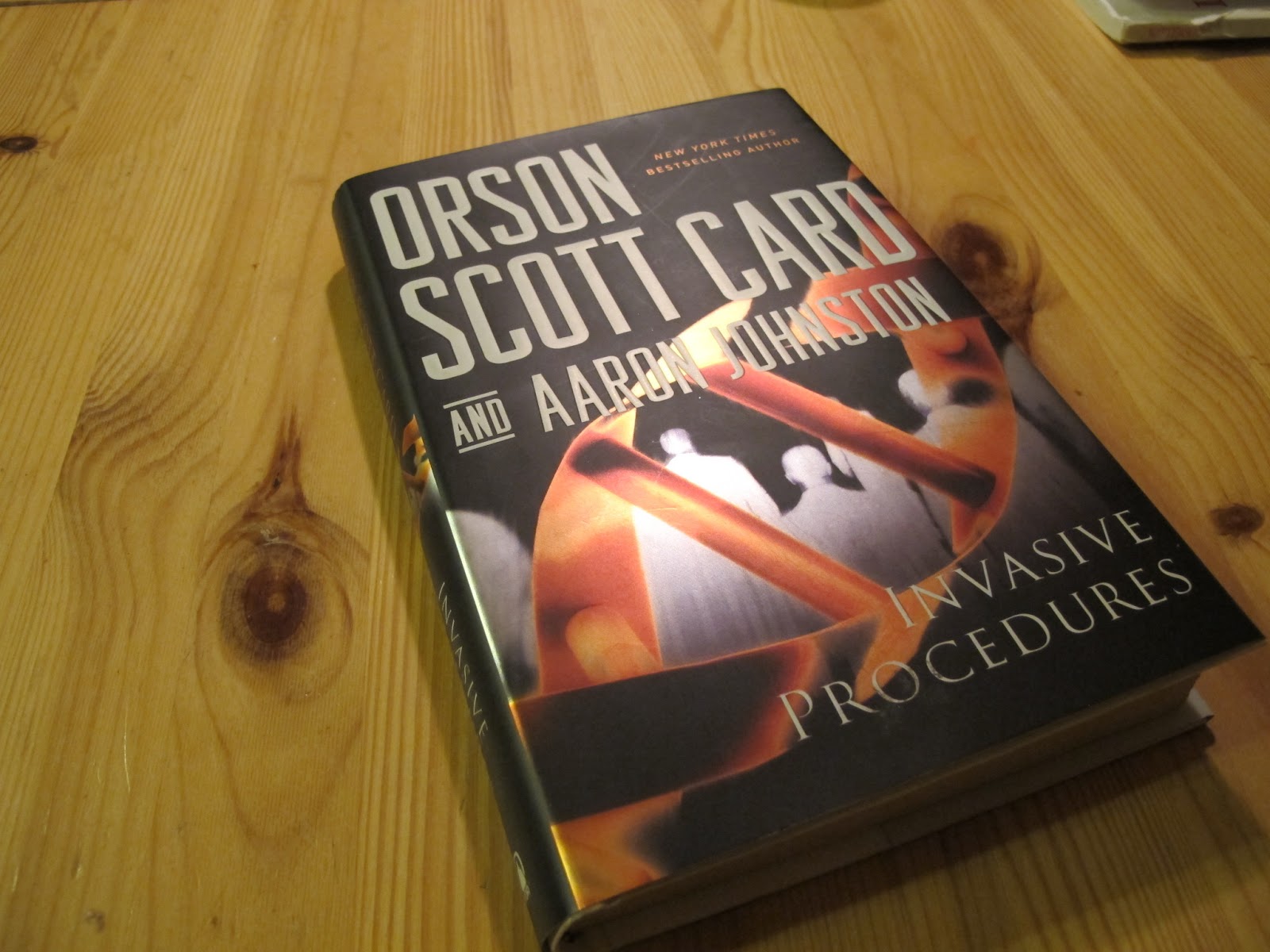
The outside.
This first photo was taken after the
job was complete. My wish for a correlation between physical mass and
literary quality took a step toward fulfillment. It's strange to heft
a book that's a third it's expected weight, but still solid and
inflexible.

The inside.
See all the great book titles on the
left page? See the cool title page design on the right? That's the
place to stop reading this book.
Along the bottom edge, a gap is visible
a few pages down. That's where the loose preface pages end and the
bibliocrypt begins. Wanna see it?

Ah. That's better!
Heather's instructions at this stage of
fabrication:
“Apply an unholy amount of glue to
the inside of the book, and to the ½" border of the first page.
Really, go nuts! If it doesn't look like a six year old was
responsible when you're done, you screwed up.”
The clean lines of the excised portions
were very pleasing to me, especially compared with my previous
attempts as a kid. Some waviness is seen at the interior north wall
and the bottom of the right page. My glue mixture was too thin.
Don't think for a moment the
synergistic irony of making this book useful, my editing of it, and
the title were unnoticed or un-relished.
The only advice I'd add to Heather's is
this: Don't use a scalpel with a plastic handle. They aren't designed
to take the necessary force. My project almost got gory, and
blood-spattered books don't blend well in most bookshelves.
The parting words of Ms. Rivers:
“This excessively photographic
guide to hollowing out a book is brought to you by Heather
Rivers, who begs forgiveness for her sins against bookdom and
would offer to the appalled that her book-lovin' karma is still in
great shape after having spent two years of college working in a
rare book preservation lab preserving priceless treasures that
they might continue to be celebrated by book fetishists like you for
many years to come.”
Thank Heather by visiting her site.
http://rive.rs/projects/how-to-hollow-out-a-book
Tell her Derick sent you. She'll have
no idea who you're talking about.
Wednesday, November 7, 2012
My Favorite Hoodie I Hate
New sailors have good stories. More so the old ones. I like
the officers, too, once they've retired and calmed down.
I've also watched sailors have a hard time being good husbands and dads while in the Navy. I'm sure there are worse things, though. Like heroin addiction. Being in the mob. I've used the same effort in avoiding all three.
Veterans.
My hoodie's hood off to you.

I've also watched sailors have a hard time being good husbands and dads while in the Navy. I'm sure there are worse things, though. Like heroin addiction. Being in the mob. I've used the same effort in avoiding all three.
I learned this living next to a naval base in a city I loved.
It was the first place I felt at home since leaving home. My roommate was a
great friend, and the first willing to point out some traits of mine which
needed to go. He also got me hooked on mountain biking.
He and I did a lot of volunteer work, which lead us one
chilly fall Saturday to the house of a friend of a friend. A sailor.
Sailor was improving the yard of his small suburban two-story.
Friend was a landscape architect and couldn't resist the blank canvas. Sailor
needed a hand as he'd recently injured his back and his daughters were only
five and three. That's where Roommate and I joined the fun. Roommate could dig
holes with his bare hands, and I'd worked for my dad's landscaping company as a
kid.
I relived my childhood a little too much. Roommate put a rake
behind me, tines up, just to mess with me when I saw it. Except that I didn't.
I gained empathy for that mouse-tortured cartoon cat as I took a rake handle to
the nose. Roommate wet himself.
It took more than one Saturday, but Sailor and Friend and
Roommate and I turned a cookie cutter yard into a modest work of art. We also
turned a stranger into a good friend and his daughters into surrogate nieces. I
realized we meant a lot to the Sailor family. We'd helped make a better place
for Mrs. Sailor and the girls to live; no trivial comfort when Sailor was
deployed for six months. Without us, Sailor wouldn't have been able to finish
before leaving. Some weeks later, they asked us to drop by for lunch. They were
having Christmas early before Sailor left, and there were two gift-wrapped
packages waiting, one for Roommate, one for Me.
They were hoodies. Cozy comfy identical ones. Roommate threw
his on like a kid at Christmas because he was and it was close enough. I still
held mine and stared at the front. I couldn't get past the giant navy blue
letters which spelled NAVY. This will look great inside-out, I thought. The
Navy embodied the opposite of everything I wanted to do with my life. My memory
flashed to other sailors' stories, the ones which weren't good. Some
terrible.
“Picture time!” Roommate said. He was on the couch with the
girls on his lap, Mrs. Sailor setting the flash on the camera. I shook off my
hesitation, glad no one had read what was in my head, hoping Roommate's
reaction drew attention from mine. I pulled the hoodie on, right side out, and
helped fill a few scrapbook pages.
I moved next spring and lost contact with the Sailor family.
I miss their upstate New York accents, and wonder if they ever got back there
as they were hoping. I saw Roommate at his
wedding. I'm glad we caught up one last time, as his funeral was only two
years later.
I still dislike what it says on that hoodie. But now it
represents some of my most important memories of life as a single guy. That's
why it still hangs in my closet, why it still gets worn.
Isn't that the point? To move past superficial impressions or
irrelevant distractions to get at real meaning? To understanding Them enough we
all become Us.
Veterans.
My hoodie's hood off to you.

Monday, October 8, 2012
Poutine for Thanksgiving
I asked Shelly
to post another article. She's only had three months of grueling editing
on a book she doesn't even like. I offered to soak her worms in Worcestershire
sauce, but even then the deal wasn't sweet enough. If you don't believe I had
to write this myself, read on. This is as un-Shelly as it gets.
I love Turkey
Day, and I love Canada. As a kid at Grandma's house, the eleventh fourth
Thursday was cousins and no chores and a pumpkin pie all to myself. In 2002,
after moving back from living a year in Canada, I got to watch the Olympic
hockey medal ceremonies live in Salt Lake City.
Though I'm a U.S. citizen, I sang “O Canada” as loudly as I could while
the men's and women's teams got their golds. Yep. I know the whole first verse.
I now celebrate
Thanksgiving in November and October. I'm sure Mr. Columbus doesn't care
Canadian Thanksgiving is the same day as his. This way I get a gratefulness
holiday in which I have to ignore commercialism and one in which there's
none to ignore. So, here are my gratefulness musings for 2012.
I'm healthy. I
can do what I need to and what I want to with few limitations. Part of my
holiday weekend was a fund-raising bike ride from a city park to a lodge, ten
miles away and 2000 feet up. Oh, sorry, eh. That's 16 kilometers and 610
meters. From there, up another 610 on trails. I made it. To the top. No
past injuries or congenital problems or lifestyle diseases hindered me. From
there I could be grateful for a fantastic landscape that spanned two states. It
would have been three and a certain foreign country, but there was obscuring
smoke from wildfires. Which is gratefulness topic number three: the fires
missed me.
Lest anyone
think I'm boasting, I'll point out I was the last of fifty-odd entrants to
summit. Two years in a row. One guy who passed me early on was older and
completely gray. That hurt the ego until I saw his jersey front later. U.S.
Marine Corps. So don't take me for a mountain bike poser, either. Half the riders skipped the first half and started at the lodge. A dozen or so
of them didn't summit at all. One man asked
if I was still in college. While jotting down my thoughts a lady asked if I was
doing my homework. That was back down at the lodge, in the sun, with a barbeque
and a live band. Not my kind of music, but the lead singer was great. If I
closed my eyes, I would swear Billy Joel was there in the National Forest.
Gratefulness
topic number four: none of those things happen in a peace-less place. No music,
no relaxation, no expending of that much energy for health or uplifting
entertainment. And nothing but weeds. I know because I've lived in places where
the gunshots were not hunting rifles and not limited to a few
weeks every year.
Number five:
Shelly finds my kids obnoxious. Well, ma'am, they do wash their hands
after pooping now. Mostly. They're healthy and good natured and I love 'em. As
long as I'm un-apologetically sentimental, I'll tell you I love my wife tons,
too. They're my favorite people and I get to see them every day. So think on that
while you're unconscious, all by yourself, morosely buried in the cold winter
ground.
That doesn't...
I need to work on my turtle insults. Or I could be grateful I've never needed
to have good insulting skills.
Six.
P.S.
This is the time of year I start making plugs for my favorite non-profit organization. Kiva combines microloans of $25 from people in developed nations to help those whose history has been unstable. All my loans have been repayed, and quickly. Rather than reclaim that money, I've relent it several times over just like most of the others who lend. And Kiva never takes a cut. They're funded by donations.
Friday, March 9, 2012
An Almost Super Interview with Marion Jensen
Well,
here I go again. Another mix of author, answer-girl, and interview.
But the good news is my attitude. After doing a few of these now, I
realize I don't hate talking to writers. Probably because they
aren't normal human beings.
Today's
guest is author Marion Jensen, the imagination behind Almost
Super. So,
Mr. Jensen, give us the teaser.
MJ:
A teaser . . .
it's like Harry Potter meets Lord of the Rings meets the Bible . . .
what other bestsellers am I leaving out? Ha ha, only teasing. Get it?
Teasing? Teaser? I crack myself up.
StBT:
The
main character actually or metaphorically dies and comes back to
life? That's both morbid and
fantastic!
MJ:
Kidding
aside, Almost Super is about two brothers who are born into a
Superhero family. They have it all. Cool gadgets. Action and
adventure at every turn. And the chance to be heroes by saving the
day. But on the day they are supposed to receive their powers,
something terrible happens. They receive worthless powers, and they
are left with the horrible fact that they are normal in a family of
heroes. How the brothers react makes up the rest of the story. The
tagline in Publishers Weekly called it Savvy meets The Incredibles.
StBT:
I like that
conflict. I like the Incredibles. I like, have to look up Savvy.
What's the deal
with humans and superheroes? Is it a desire to be better? To have
life easy and carefree? Take no offense, but I wonder if it's
compensation for your terrible evolutionary outcome. No claws,
fangs, prehensile tail, or wings. No shell!
But normal
protagonists in a superhero setting? That gets me interested. If it
weren't for brains and opposable thumbs, humans would be long
extinct. So how do the brothers compensate in their survival of the fittest?
MJ:
Well
. . . no claws, fangs, or wings that you can see. I have to
fit in, don't I?
StBT:
Good
point. (backing away slowly)
MJ:
I
had one editor tell me that I should have the kids save the day by
using their worthless powers. But that actually goes against the
message of the book. Without giving anything away, the boys' powers
are just given to them. They don't have to do earn them. Granted,
they're worthless powers, but I didn't want some easy-to-earn power
that allowed the boys to save the day. In the end, what saves the day
is boys who decide they aren't going to let the rest of the world peg
them as worthless.
As far as finding use in their lame powers . . . there are no redeeming qualities to these powers. Really. They're completely worthless.
StBT:
A
book with a moral? Implying one is in charge of one's situation by
the decisions made? What are you trying to do, make kids feel guilty about laziness and irresponsibility?
That's harsh.
You
said the boys save the day.
MJ:
Well,
they save the day, but I've said nothing about whether or not they
save the week. Or the month. And as far as the fortnight goes . . .
it's anybody's guess.
StBT:
That
means no clues about a Harry-Potter-time-skip-to-the-train-station
scene? You're holding the cards pretty close, Mr. Jensen.
What
sparked the first idea for the book? Then, as you wrote, what
influences were most helpful in rounding out your prehensile tale?
MJ:
You
know, I honestly can't say what sparked the idea for the book. I was
in bed one night and I had the idea of two brothers who had rotten
superpowers. In just a few hours I had the story, the characters, the
arcs, the idea for powers . . . it all just seemed to flow into me.
It was a very fun experience. Of course, then it took me four years
to write and polish the thing. I spent a lot of time learning the
craft of writing.
As
far as influences, I love a good parody. My favorite comic book hero
is The Tick. The Tick universe pretty much makes fun of, in a loving
way, the world of superheroes. The Incredibles did this to some
extent. I think my book does this as well. It's not your normal
superhero story. It pokes fun of these heroes, makes them not quite
as heroic, but in the end you still can't help but love them.
StBT:
Bed
and relaxing. See? Mammals think of us ectotherms and pondering types
like Mr. Jensen as a bunch of lazies, while they run around
crazy, eating in cars and not sleeping enough. A parody begs to be
written. Now, cats are an exception. They get it, their naps
in sunshine and all. Speaking of which, any spunky sidekick almost
super-pets? I promise I won't take offense if none are reptiles.
MJ:
Nope,
sorry. No sidekicks, reptilian or otherwise. You see, the problem
with sidekicks is that they're always popping up behind you in the
publicity photos. And you can't have that.
StBT:
No.
Not at all. DWD keeps sneaking posts into this blog. Drives me crazy.
I'm
sure everyone here wants to know when they can storm the stores for
it. And your fellow writers want to know your publisher and agent.
But I want to know what the cover looks like.
MJ:
Certainly.
My book will be published by HarperCollins. The tentative date is
Fall of 2013. We're very early on in the process, so still a lot to
do. Of course, it's never too early to go stand in line.
StBT:
Or
hibernate in line. My door-buster endurance is legendary.
MJ:
My
agent is the very wonderful Sara Crowe with Harvey Klinger. Sara is
really great. I can't say enough about her.
As
far as the cover . . . I'd kind of like to know what it looks like
too. All in good time, I guess. All in good time.
StBT:
My
curiosity prods me to ask – who's the audience you hope to
entertain?
MJ:
That
is a great question. C. S. Lewis once said, "A children's story
that can only be enjoyed by children is not a good children's story
in the slightest."
I
think a good story can mean different things to different people.
Look at The Incredibles. It's probably my favorite Pixar movie. My
kids love it because of the action, the characters, and the jokes. I
love it because I can relate to the father and the fears he struggles
with throughout the movie. If a story carries real emotion, then I
think it can appeal to a broad audience.
I
know it's a lofty goal, but I like to think that Almost Super isn't
just for kids. I think it will be enjoyed by anybody who has had
dreams of being somebody special.
StBT:
That
would be me. Shelly the Grassland Ankylosaurus. But that dream was
severed by a taxonomical split and then shattered by an asteroid. Stupid space gravel.
Well,
Mr. Jensen, thanks for the preview of Almost Super. I look
forward to it. In fact, I'm swiping DWD's credit card as soon as I
hear whisperings of pre-orders.
Subscribe to:
Posts (Atom)